Picking up some of my previous research (Dini, 2025), I asked myself: What would result from combining microkernels and outsourcing? Well, it’s pretty interesting I must say, although maybe not so easy to explain.
Starting from the software architecture realm, the PCMag Encyclopedia defines a kernel as:
The nucleus of an operating system. […] The kernel orchestrates the entire operation of the computer by slicing time for each system function and each application as well as managing all the computer’s resources… (kernel, n.d.)
From a business perspective, the way a company is run could be regarded as its operating system: What procedures are followed and how are its processes executed since it opens until it closes? One could also consider the strategic and tactical levels as the kernel, since they “orchestrate the entire operation of the” company, by managing the human resources and the use of machines, in order to satisfy/complete clients’ orders and requests. This would be the equivalent of a monolithic kernel, which PCMag Encyclopedia defines as:
An operating system architecture for a particular platform that includes all OS functions such as the file system, virtual memory manager, application interprocess communication and drivers. (monolithic kernel, n.d.)
However, there’s also a reduced or simplified kind of kernel. It’s our gold nugget:
A microkernel (abbreviated 5K or uK) can be considered a compact kernel as it performs only the basic functions universal to all computers. Designed to be integrated into different operating systems […] A microkernel is a component-based structure which improves portability at the expense of performance. (webopedia, n.d.)
Therefore, the microkernel could be translated as a particular kind of strategic level, which would perform only the essential (high-level) functions universal to all companies. It might thus be applied to different industries.
Defining Extreme Outsourcing
In order to analyze the “component-based structure,” we’ll now delve into the outsourcing realm. Lexico defines outsourcing as the obtention of “(goods or a service) from an outside or foreign supplier, especially in place of an internal source” (outsource, n.d.). Exaggerating this definition as much as possible, one could define extreme outsourcing as the obtention of goods and services from suppliers, without using internal sources at all, while keeping a minimalistic corporate structure. If one were to consider the make-or-buy question, this would definitely be a buy case, without making absolutely anything in-house.
Although I didn’t come up with the extreme outsourcing idea (Taulli, 2005), many will probably find this connection between the two realms useful. In fact, based on my knowledge of and experience, I can assure you that many concepts, procedures, and even optimizations that have been traditionally applied to each realm on its own are compatible with both of them.
The Component-Based Enterprise
To visualize this extrapolation from the software architecture realm to the corporate realm, we must look at the “component-based structure.”
In a traditional “monolithic” company, departments (HR, IT, Logistics) are fixed internal structures—much like the file systems and drivers hard-coded into a monolithic operating system. In the Microkernel Business Model, the company retains only the strategic core—the history, vision, and decision-making power—and treats all other functions as interchangeable components.
This allows the strategic level to activate or deactivate components at will. Just as a microkernel improves portability, this business structure improves agility. If a specific marketing agency (component) is underperforming, it’s “deactivated” and replaced without the trauma of internal restructuring.
The Translation Matrix
To fully appreciate the extreme outsourcing model, we must move beyond the metaphor and look at the functional equivalents. By mapping the software components defined by the PCMag Encyclopedia to specific business departments, we create a clear blueprint for this minimalistic structure .
The following table illustrates how the software functions translate directly into business functions:
| Software Component | Function | Business Equivalent | Business Function |
| The Microkernel | Orchestration, IPC (Inter-Process Communication), Scheduling. | Strategic Management | Planning, Monitoring, Controlling, and Vision. |
| Device Drivers | Interfaces with physical hardware (printers, disks, video cards). | Logistics & Manufacturing | Interfaces with the physical world (3PL/4PL, Contract Manufacturing) to move and create goods. |
| File System | Manages data storage, retrieval, and organization. | BPO & ITO | Manages back-office processes, data storage, and record-keeping (HR, Finance, IT Infrastructure). |
| User Interface (UI) | Handles interaction between the system and the user. | Sales, Marketing & CRM | Handles interaction between the company and the customer. |
| System Libraries | Shared resources used by various applications. | Procurement & SRM | Sourcing resources and managing supplier relationships required by various departments. |
Visualizing the Architecture
To summarize, this extrapolation from the software architecture realm to the corporate realm can be visualized by mapping the components directly.
In the diagram below, observe how the structure of a microkernel operating system—where functions are pushed out to external drivers—mirrors the extreme outsourcing business model, where departments are pushed out to external vendors.
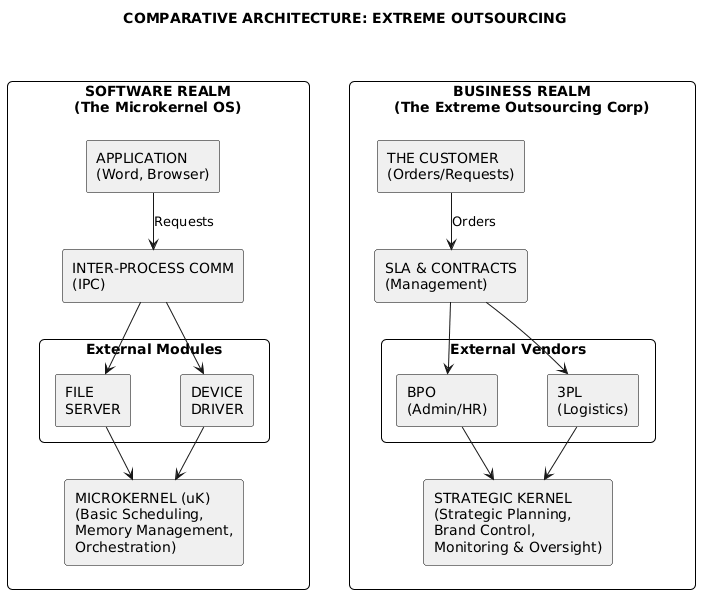
The Core (The Kernel): On the left, the microkernel performs only basic functions universal to all computers. On the right, the strategic kernel performs only the essential high-level functions universal to all companies, such as strategic planning and brand management.
The Modules (The Components): Just as a microkernel uses a component-based structure to offload file systems and drivers, the business offloads Logistics (3PL), HR (HRO), and Manufacturing to specialized partners.
The Glue (The Connection): In software, the kernel uses Inter-Process Communication (IPC) to talk to components. In business, the strategic kernel uses SLAs (Service Level Agreements) and contracts to orchestrate the operation. This architecture allows the strategic level to activate or deactivate components with minimal disruption, replacing a vendor (component) rather than restructuring an entire internal department.
Scalability: The AWS Analogy
This model is conceptually similar to the revolution seen in cloud computing, specifically with services like AWS (Amazon Web Services). In the past, companies bought physical servers (fixed assets/monolithic). Today, they use AWS to scale computing power up or down instantly based on traffic.
Extreme outsourcing applies this logic to the corporate structure. The company becomes a scalable platform where resources (outsourced teams) are provisioned only when needed, shifting the business from a CAPEX (capital expense) heavy model to an OPEX (operating expense) flexible model.
The Ecosystem of Modules
For the kernel to function, it needs a robust ecosystem of service providers. The internal team focuses strictly on planning, monitoring, and controlling these external vendors. The operational modules include:
- Supply Chain: Procurement and SRM (Supplier Relationship Management) handled by specialists.
- Production: The use of additive manufacturing (3D printing) or contract manufacturing to produce goods without owning factories.
- Operations and administration:
- BPO (Business Process Outsourcing) and BPaaS (Business Process as a Service) for back-office tasks.
- HRO (Human Resources Outsourcing) for recruitment and payroll.
- ITO (Information Technology Outsourcing) for infrastructure.
- RDO (Research and Development Outsourcing) for innovation.
- Logistics: Utilization of 3PL (Third-Party Logistics) or 4PL providers who manage the entire supply chain without the company owning a single truck or warehouse.
- Growth: External partners handling Marketing, Sales, and CRM (Customer Relationship Management).
Risks, Advantages, and Compatible Industries
This model is not without its trade-offs. As noted in the definition of the microkernel, this structure “improves portability at the expense of performance.”
| Advantages | Risks |
| Flexibility: Rapid adaptation to market changes. | Performance latency: Managing external vendors can create communication delays, similar to the overhead in microkernel message passing. |
| Focus: The kernel team focuses 100% on strategy and brand. | Loss of control: Over-reliance on partners can be dangerous if a key vendor fails. |
| Cost efficiency: No bloat from underutilized internal departments. | IP security: Sharing proprietary information with RDO or manufacturing partners carries risk. |
This structure works best in industries where the value lies in the brand and intellectual property, not the physical execution. A classic example is Coca-Cola. While they are a massive entity, their core kernel is the secret formula and the marketing strategy. The physical production (bottling) and distribution are largely handled by a vast network of independent bottling partners—a real-world execution of the microkernel concept.
Conclusion: The Future is Modular
Ultimately, extreme outsourcing is not just about cutting costs; it is about architectural agility. In an era where market conditions shift overnight, the companies that survive will not be the ones with the largest internal resources, but the ones with the most efficient kernels. By adopting a microkernel mindset, businesses can ensure that while their components may change, their core strategy remains robust, scalable, and secure.
References
- Dini, V. (2025). Microkernel-Based Web Architecture: Design & Implementation Considerations.
- Lexico. (n.d.). outsource. Retrieved April 01, 2020, from Lexico: https://www.lexico.com/en/definition/outsource
- PCMag. (n.d.). kernel. Retrieved April 01, 2020, from PCMag Encyclopedia: https://www.pcmag.com/encyclopedia/term/kernel
- PCMag. (n.d.). monolithic kernel. Retrieved April 01, 2020, from PCMag Encyclopedia: https://www.pcmag.com/encyclopedia/term/monolithic-kernel
- Taulli, T. (2005, October 5). Extreme Outsourcing. Retrieved 04 04, 2020, from Forbes: https://www.forbes.com/2005/10/05/entrepreneurs-tomtaulli-ecommerce-cx_tt_1005straightup.html
- webopedia. (n.d.). microkernel. Retrieved April 01, 2020, from webopedia: https://www.webopedia.com/TERM/M/microkernel.html